
What Is Conversion Rate Optimization? The Complete Guide for 2026
7 September, 2026
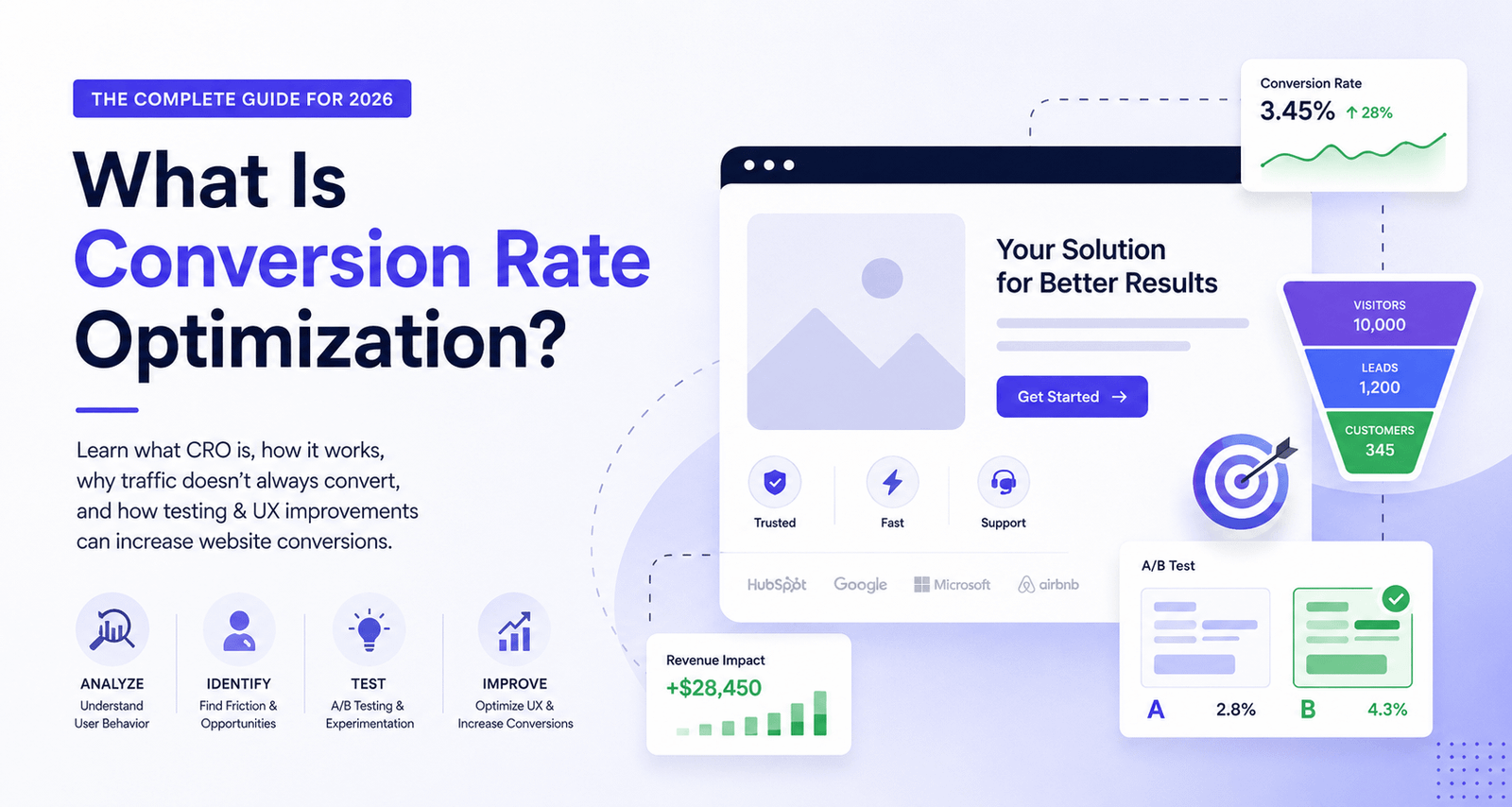
Conversion Rate Optimization (CRO) is the systematic process of improving a website or digital experience so a higher percentage of visitors complete a desired action. Modern CRO combines analytics, user research, UX, behavioral psychology, conversion-focused messaging, experimentation, personalization, and technical optimization to improve measurable business outcomes.
In 2026, CRO is no longer limited to changing button colors or running isolated A/B tests. It has evolved into a comprehensive approach to understanding why visitors behave the way they do, where they encounter friction, and what changes can make their journey clearer and more effective.
Whether your goal is to generate qualified leads, increase ecommerce sales, get more demo requests, or improve sign-ups, CRO helps you get more value from the traffic your website already receives.
The modern CRO principle: Don't optimize what you assume is the problem. Audit the experience, identify the friction, build an evidence-based solution, test it, and iterate.
What Is Conversion Rate Optimization?
Conversion Rate Optimization (CRO) is the process of increasing the percentage of website visitors who complete a specific conversion goal.
A conversion depends on the business model. It can include:
- Making a purchase
- Submitting a contact form
- Booking a consultation
- Requesting a demo
- Starting a free trial
- Creating an account
- Signing up for a newsletter
- Calling a business
- Adding a product to a cart
The basic conversion rate formula is:
Conversion Rate = (Number of Conversions ÷ Number of Visitors) × 100
For example, if 10,000 visitors generate 300 conversions:
300 ÷ 10,000 × 100 = 3% conversion rate
Conversion rate is an important CRO metric, but it should not be treated as the only measure of success. A strong CRO program also considers qualified leads, revenue, customer acquisition cost, average order value, and other downstream business outcomes.
Why Is Conversion Rate Optimization Important?
Generating traffic is only one part of digital marketing.
SEO, paid advertising, social media, email marketing, and content marketing bring visitors to your website. CRO focuses on what happens after they arrive.
Consider two websites receiving the same amount of traffic:
Website A
100,000 visitors × 1% conversion rate = 1,000 conversions
Website B
100,000 visitors × 2% conversion rate = 2,000 conversions
Website B generates twice as many conversions without requiring twice as much traffic.
This doesn't mean CRO should replace SEO or other acquisition strategies. The strongest digital growth strategies combine both:
Relevant traffic + effective conversion experience = stronger marketing efficiency
CRO can also reveal problems that traffic reports alone cannot explain, including:
- Weak value propositions
- Poor message match
- Unclear calls to action
- Complicated forms
- Confusing navigation
- Poor mobile experiences
- Checkout friction
- Lack of trust
- Technical usability problems
For ecommerce businesses, the opportunity can be particularly significant. Baymard's latest research puts average documented online shopping cart abandonment at 70.22%, based on 50 different studies.
However, that number should not be interpreted as 70% of shoppers being lost because of bad UX. Baymard's latest research found that 42% of U.S. online shoppers who abandoned a cart said they were just browsing or were not ready to buy. These users may be difficult or impossible to recover through checkout optimization alone.
That distinction illustrates an important CRO principle:
Optimize the problems you can influence—not every visitor who fails to convert.
Traditional CRO vs. Modern CRO
Traditional CRO often focused on isolated page elements such as headlines, images, buttons, and forms.
Those tests can still be valuable, but modern CRO takes a broader view of the customer journey.
| Traditional CRO | Modern CRO |
|---|---|
| Gut-feel hypotheses | Research-backed hypotheses |
| Isolated page changes | Full customer-journey analysis |
| Basic analytics | Behavioral and funnel analytics |
| One-size-fits-all experiences | Contextual personalization |
| Simple A/B testing | Multiple experimentation methods |
| Conversion rate as the primary KPI | Revenue and business outcomes |
| Desktop-focused optimization | Mobile and cross-device optimization |
| Manual analysis | AI-assisted analysis and segmentation |
Modern CRO does not mean adding AI or sophisticated technology simply because it is available.
The technology should help answer practical questions:
- Who is converting?
- Where are visitors dropping off?
- Why are they struggling?
- Which opportunity should be prioritized?
- What change is worth testing?
- Did the change actually improve the business outcome?
That is the difference between technology-led CRO and evidence-led CRO.
The Modern CRO Framework: Audit → Build → Test → Iterate
A practical CRO program can be organized into four stages:
AUDIT → BUILD → TEST → ITERATE
This framework creates a continuous optimization cycle instead of treating CRO as a one-time website redesign.
1. Audit: Identify Conversion Friction
The first step is understanding what is happening.
A CRO audit can examine:
- Website analytics
- Conversion funnels
- Landing pages
- User behavior
- Heatmaps
- Session recordings
- Forms
- Calls to action
- Navigation
- Mobile usability
- Page performance
- Checkout flows
- Customer feedback
- Search intent
- Paid advertising intent
Quantitative data can tell you where visitors are dropping off. Qualitative research helps explain why.
For example, analytics may show that users frequently abandon checkout. That doesn't automatically mean the checkout is too long.
The underlying issue could be:
- Unexpected costs
- Limited payment options
- Technical errors
- Unclear delivery information
- Weak returns information
- Forced account creation
- Lack of trust
Good CRO investigates the cause before recommending the solution.
2. Build: Turn Insights Into Improvements
Once research identifies a problem, develop a specific improvement.
Potential changes can include:
- Rewriting a weak headline
- Clarifying the value proposition
- Simplifying a form
- Improving CTA messaging
- Restructuring a landing page
- Adding relevant social proof
- Clarifying pricing
- Improving mobile navigation
- Reducing unnecessary checkout steps
The objective is not to redesign everything simultaneously.
Every change should have a clear connection to an observed problem, user need, or business opportunity.
For example:
Weak approach:
"Let's redesign this page because it looks outdated."
CRO approach:
"Research indicates that visitors don't understand the core offer quickly enough, so we'll test a clearer
value proposition and supporting proof."
3. Test: Validate the Hypothesis
A proposed change should become a testable hypothesis.
For example:
Hypothesis: Replacing "Submit" with "Get My Free Quote" will increase qualified form submissions because the new CTA communicates the value of the next step more clearly.
Depending on the situation, businesses can use:
- A/B testing
- Multivariate testing
- Server-side experimentation
- Usability testing
- Personalization experiments
A/B testing is important, but A/B testing is not synonymous with CRO.
CRO is the complete research and optimization process. Testing is one tool within that process.
Current experimentation data shows how broad testing has become. VWO's 2026 benchmark covers 38,000 websites, 193,000 experiments, and 270,000 variations across 17 industries. CTA copy was the most-tested tactic in its dataset, with approximately 3,500 tests and an approximately 10% reported win rate. Site search was among the least-tested areas but had a reported win rate of around 12%.
These figures should be treated as industry-level observations, not guaranteed results for an individual website.
The right experiment depends on your audience, traffic, funnel, product, and business objective.
4. Iterate: Learn From Every Experiment
CRO doesn't end when an experiment finishes.
A successful test can establish a new baseline. An unsuccessful test can show that a hypothesis was wrong. An inconclusive result can indicate that additional research is needed.
The cycle continues:
Audit → Build → Test → Iterate → Audit Again
This is what makes CRO an ongoing discipline rather than a one-time website redesign.
Behavioral Psychology and CRO
People don't always make online decisions purely rationally. Behavioral psychology can help CRO teams understand hesitation, choice overload, uncertainty, and perceived risk.
Hick's Law
Hick's Law suggests that the time required to make a decision can increase as the number of choices increases.
In practical CRO terms, a landing page with several competing CTAs may create more cognitive load than a page with one clearly prioritized next step.
The solution isn't to remove every choice. It is to make the intended next action clear.
Loss Aversion
People can be particularly sensitive to potential losses.
For example, messaging around avoiding unnecessary costs, missing an opportunity, or losing access to a benefit may sometimes be more persuasive than generic statements about potential gains.
However, psychological principles should be treated as hypotheses, not guaranteed conversion formulas.
Friction Reduction
Friction is anything that makes completing an intended action unnecessarily difficult.
Examples include:
- Excessive form fields
- Complicated navigation
- Unexpected costs
- Slow interactions
- Poor mobile usability
- Confusing instructions
- Complicated checkout processes
The goal isn't to eliminate every step. It is to remove unnecessary friction while preserving the information users need to make confident decisions.
AI-Powered Personalization and Predictive CRO
AI is becoming increasingly useful in conversion optimization.
Machine learning and behavioral analysis can help businesses identify patterns such as:
- High-intent visitors
- Returning customers
- Product comparison behavior
- Different acquisition sources
- Engagement patterns
- Potential abandonment signals
These insights can support:
- Personalized product recommendations
- Contextual content
- Behavioral segmentation
- Dynamic messaging
- Relevant offers
- Different experiences for different stages of the customer journey
For example, a returning visitor who has repeatedly viewed a product may have a different intent from someone visiting the website for the first time.
However:
More personalization does not automatically mean better CRO.
Poorly implemented personalization can feel intrusive, create inconsistent experiences, or introduce privacy concerns.
The goal should be:
Relevance + Transparency + User Control + Business Value
First-party and zero-party data can also support more relevant experiences when collected and used responsibly.
What Should You Test in CRO?
The most valuable CRO tests depend on the problems identified during research.
Landing Pages
Test:
- Headlines
- Value propositions
- Benefits
- Page structure
- Images
- Social proof
- CTA placement
- CTA copy
Forms
Test:
- Number of fields
- Field labels
- Form placement
- Supporting copy
- Error messages
- CTA language
Ecommerce
Test:
- Product information
- Pricing presentation
- Reviews
- Shipping information
- Returns information
- Cart experience
- Checkout flow
- Payment options
User Experience
Evaluate:
- Navigation
- Site search
- Mobile usability
- Content hierarchy
- Page speed
- Error handling
The key principle is:
Don't test something simply because it is easy to test. Test something because evidence suggests it could improve the user or business outcome.
CRO Metrics That Matter
Conversion rate is important, but it should not be the only KPI.
| Metric | What It Measures |
|---|---|
| Conversion Rate | Percentage completing the desired action |
| Revenue Per Visitor | Financial value generated by traffic |
| Average Order Value | Average ecommerce transaction value |
| Cost Per Acquisition | Cost of acquiring a customer or conversion |
| Cost Per Lead | Cost of generating a lead |
| Lead-to-Customer Rate | Quality of generated leads |
| Micro-Conversion Rate | Progress toward a primary conversion |
| Form Completion Rate | Potential form friction |
| Cart Abandonment Rate | Percentage of carts that don't become purchases |
Don't Optimize for the Wrong Metric
A higher conversion rate does not automatically mean better business performance.
Suppose an experiment increases form submissions by 25% but produces fewer qualified leads.
The conversion rate improved.
The business result did not.
This is why mature CRO programs connect website metrics with downstream outcomes such as:
- Revenue
- Qualified leads
- Customer acquisition cost
- Customer lifetime value
- Retention
- Profitability
Technical Performance and CRO
Technical performance is part of the user experience.
A slow, unstable, or difficult-to-use website can create friction before visitors even have the opportunity to evaluate the offer.
Technical CRO considerations include:
- Page speed
- Mobile responsiveness
- Visual stability
- Interaction responsiveness
- Form functionality
- Broken links
- JavaScript errors
- Checkout errors
- Search functionality
Technical performance should not be confused with CRO itself.
A technically fast website can still have poor conversion performance if its messaging, offer, UX, trust signals, or customer journey are weak.
Ecommerce CRO: Where Conversion Friction Can Hide
For ecommerce businesses, ecommerce conversion optimization extends across the entire shopping journey. Important areas include product discovery, site search, filters, product pages, reviews, pricing, shipping information, shopping cart, checkout, payment methods, and returns information.
Baymard's current research puts average documented cart abandonment at 70.22%. Its research also identifies several abandonment reasons that businesses can potentially address through UX improvements, including extra costs, slow delivery, trust concerns, forced account creation, and complicated checkout processes.
Baymard's 2026 data reports:
- 40% abandoned because extra costs were too high
- 20% because delivery was too slow
- 19% because they didn't trust the site with their credit card information
- 18% because the site wanted account creation
- 17% because checkout was too long or complicated
- 17% because the website had errors or crashed
These figures demonstrate why checkout optimization should go beyond simply reducing the number of pages. Baymard's research also found that an ideal checkout can be as short as 12–14 form elements, while its benchmark database found an average of 23.48 form elements displayed by default.
However, CRO should distinguish between avoidable and unavoidable abandonment. Price comparison, window shopping, and visitors who aren't ready to purchase are not necessarily UX failures. The goal is to isolate the friction your business can realistically fix.
CRO, SEO, AEO and GEO: How They Work Together
CRO and search optimization should work together rather than operate as separate disciplines.
SEO
SEO attracts relevant organic traffic.
CRO
CRO helps turn that traffic into meaningful actions.
AEO
Answer Engine Optimization structures information so answer engines can understand and surface direct answers.
GEO
Generative Engine Optimization focuses on creating useful, authoritative information that can be understood and referenced within generative search experiences.
A modern CRO resource should therefore use:
- Clear definitions
- Direct answers
- Logical heading structures
- Relevant terminology
- Original analysis
- Research-backed claims
- Internal links
- Expert commentary
- Clearly attributed sources
Google's guidance emphasizes helpful, reliable, people-first content, including original information, research, analysis, and evidence of expertise.
This means authoritative CRO content should not simply repeat generic "CRO hacks."
It should explain:
What works → Why it may work → When it may not work → How to validate it
That is much stronger for both users and modern search systems.
Common CRO Mistakes to Avoid
1. Testing Without Research
Random A/B testing can consume resources without producing meaningful learning.
2. Treating CRO as Button Optimization
The biggest opportunity may be the offer, messaging, pricing, checkout, navigation, or customer journey.
3. Optimizing Only for Conversion Rate
A conversion is valuable when it contributes to the desired business outcome.
4. Copying Competitors
Another company's successful experience may not work for your audience.
5. Stopping Tests Too Early
Experiments require appropriate methodology and sufficient evidence to support a decision.
6. Ignoring Mobile Users
Mobile visitors can experience very different usability problems from desktop users.
7. Personalizing Without a Purpose
Personalization should solve a genuine customer or business problem rather than simply demonstrate technical capability.
8. Ignoring Technical UX
Slow loading, unstable layouts, broken forms, and interaction problems can undermine otherwise strong CRO work.
What Is a Good Conversion Rate?
There is no universal conversion rate that is automatically considered good.
Conversion performance varies according to:
- Industry
- Business model
- Traffic source
- Search intent
- Audience
- Offer
- Price
- Conversion type
- Device
- Geography
- Funnel stage
A 2% conversion rate may be excellent for one business and poor for another.
Instead of focusing exclusively on industry averages, establish your own baseline and ask:
Are conversion quality and business performance improving over time?
Benchmarks can provide context, but your own customer behavior and business economics should drive CRO decisions.
How to Build a CRO Strategy for 2026
A practical CRO strategy can follow eight steps.
1. Define the Business Goal
Determine whether you want more qualified leads, purchases, demos, trials, bookings, or another meaningful outcome.
2. Establish a Baseline
Measure current conversion rates, funnel performance, revenue, and lead quality.
3. Identify Friction
Use analytics, user research, customer feedback, heatmaps, recordings, and technical analysis.
4. Prioritize Opportunities
Focus on opportunities with meaningful traffic, clear friction, and realistic potential impact.
5. Create a Hypothesis
Clearly state what you want to change, why you expect it to work, and what outcome you expect.
6. Build and Test
Implement the change and use an appropriate testing or research methodology.
7. Measure the Business Outcome
Look beyond clicks and headline conversion rates.
8. Document and Iterate
Record the result and use the learning to inform the next experiment.
The process then returns to the beginning:
Audit → Build → Test → Iterate
When Should You Hire a CRO Agency?
A CRO agency can be valuable when a business has meaningful website traffic but lacks the internal expertise, resources, or structured experimentation process required for continuous optimization.
A CRO agency may help with:
- CRO audits
- Analytics analysis
- User research
- Landing-page optimization
- UX analysis
- Conversion-focused copy
- A/B testing
- Funnel optimization
- Experiment prioritization
- CRO strategy
The objective should not be to make more changes.
It should be to make better decisions based on evidence.
Frequently Asked Questions About CRO
- What is the difference between SEO and CRO?
- SEO focuses on attracting relevant visitors through search, while CRO focuses on improving the percentage of visitors who complete a desired action. SEO and CRO work together: SEO can increase qualified traffic, while CRO helps turn that traffic into business outcomes.
- How long should an A/B test run?
- There is no universal two-week or four-week rule. Test duration depends on traffic volume, conversion frequency, experiment design, seasonality, and the statistical methodology being used. Tests should be planned around sufficient evidence rather than an arbitrary calendar deadline.
- What is the difference between CRO and A/B testing?
- CRO is the broader process of researching users, identifying problems, developing hypotheses, improving experiences, and measuring outcomes. A/B testing is one experimentation technique used within CRO.
- What is a good conversion rate?
- There is no universal benchmark. Conversion rates vary by industry, audience, traffic source, offer, device, and conversion goal. Your own historical performance and business outcomes are generally more useful than an arbitrary percentage.
- What should I optimize first?
- Start with the highest-value problem supported by evidence. Look for pages or funnel stages with meaningful traffic, significant drop-offs, and a clear reason to believe that an improvement could affect business outcomes.
Final Takeaway
Conversion Rate Optimization is not about finding a magic button color, copying a competitor, or running endless A/B tests.
Modern CRO is a disciplined process for understanding users, identifying friction, developing evidence-based hypotheses, improving digital experiences, and measuring whether those improvements actually create better business outcomes.
In 2026, the strongest CRO programs bring together:
- Behavioral psychology
- Analytics
- User research
- UX design
- Experimentation
- Technical performance
- AI-assisted analysis
- Personalization
- Customer feedback
- Business intelligence
But the fundamental principle remains simple:
Understand the problem before trying to optimize the solution.
The most effective framework is:
Audit → Build → Test → Iterate
When CRO becomes an ongoing discipline rather than a one-time website redesign, every experiment can create value. A successful test can improve performance. An unsuccessful test can challenge an assumption. Even an inconclusive result can reveal what needs to be investigated next.
Your website already has visitors.
The next question is whether you're giving those visitors the clearest, most trustworthy, and lowest-friction path to conversion.
Ready to identify what's preventing your website visitors from converting? Start with a CRO audit.
Research & References
-
VWO. Experimentation Benchmark Report 2026.
View the VWO 2026 Experimentation Benchmark -
Baymard Institute.50 Cart Abandonment Rate Statistics 2026
View Baymard's 2026 Cart Abandonment Research -
Baymard Institute. Cart Checkout Usability Research.
View Baymard Checkout Usability Research -
Baymard Institute. 40+ UX Statistics from 200,000 Hours of UX Research.
View Baymard UX Statistics -
Google Search Central. Creating Helpful, Reliable, People-First Content.
View Google's People-First Content Guidance -
Google Search Central. Understanding Core Web Vitals and Google Search Results.
View Google's Core Web Vitals Guidance -
Google Search Central. Top Ways to Ensure Your Content Performs Well in Google's AI Experiences on
Search.
View Google's AI Search Guidance
.svg)